
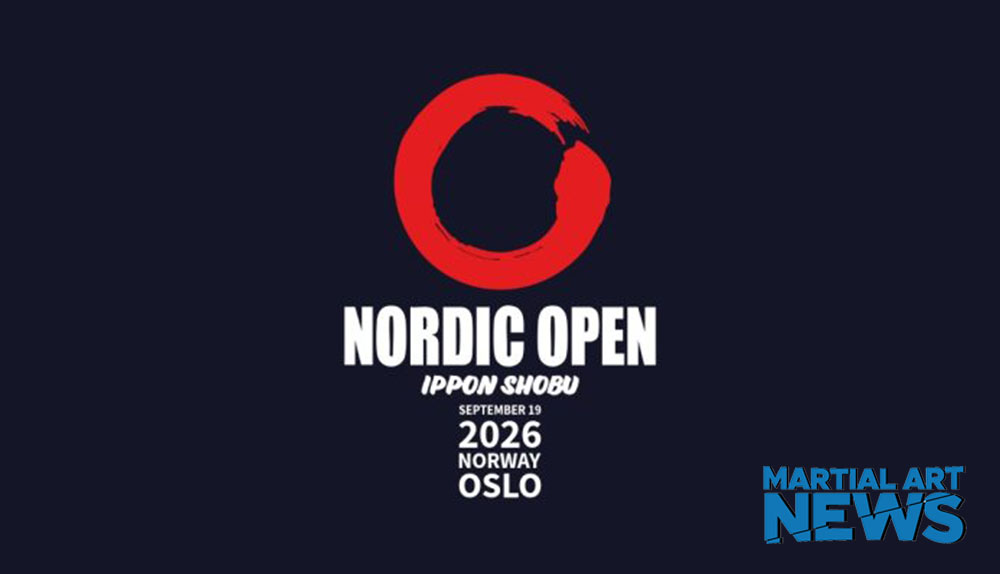

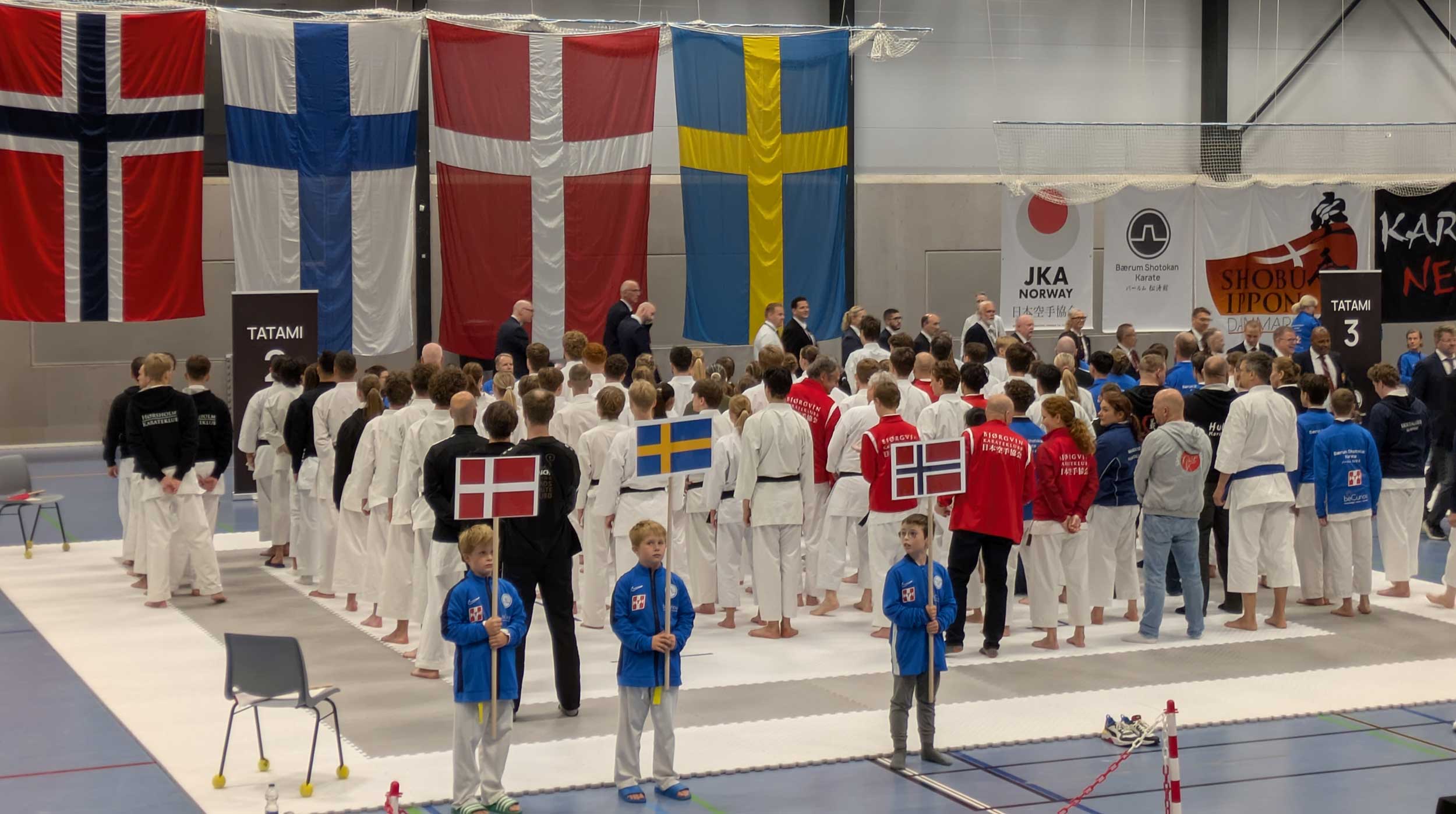
Nordic Open Karate 2026 brought the Nordic traditional karate community together in Bærum, Norway, on September 19 for a full day of kata and kumite under the Shobu Ippon format. Staged at Bærum Sports Park, the fourth edition of the tournament continued a project that has grown steadily across Norway, Denmark and Sweden and has become one of the clearest meeting points for traditional Shotokan competition in the region.
JKA Norway led the 2026 event together with Bærum Shotokan Karate Club as local host, while the wider Nordic collaboration also involved JKA Sweden and Shobu Ippon Danmark. The tournament was open to karate practitioners regardless of style or organisational affiliation, provided they wanted to compete under the traditional JKA Shobu Ippon rules. That open-door policy is central to the identity of Nordic Open: the event is not built around one federation alone, but around a shared competitive format and a common understanding of traditional karate.
The published draw and tatami plan showed a substantial programme. Across the individual divisions, 142 kata starts and 96 kumite starts were scheduled, giving 238 individual category starts before team competition was added. Three tatami were used, with classes stretching from 12–13 years through senior and veteran age groups. The largest single field was boys’ kata 16–17 years with 25 entries, followed by men’s kata 18–20 years with 19 and men’s kata 21–34 years with 17.
A Nordic project with a clear identity
The roots of Nordic Open go back to the growing cooperation between traditional karate organisations in Scandinavia. The first edition was held in Norway in 2023. Denmark then hosted the tournament in Hørsholm in 2024, where the event expanded significantly, and Sweden took its turn with Nordic Open in Ystad in 2025. The return to Norway in 2026 therefore completed another step in a genuinely rotating Nordic project.
That development has been driven by a simple idea: create more high-quality competition opportunities for karateka who want to compete according to Shobu Ippon principles.
For JKA Norway, JKA Sweden and Shobu Ippon Danmark, the cooperation also has a wider purpose. Traditional karate organisations in the region have increasingly supported each other with athletes, coaches and referees. Events in Denmark, Sweden and Norway are therefore becoming connected rather than isolated. A competitor who enters a Shobu Ippon tournament in Hørsholm can later meet many of the same opponents at a Swedish championship or at Nordic Open. Referees gain experience across national systems, while clubs establish relationships that make future exchanges easier.
That continuity was clearly visible in the 2026 entry lists. Norwegian clubs naturally formed the largest part of the field, while Sweden was represented by clubs including Fagersta, Landskrona, Lund, Hammarö and Shotokan Karateklubb Helsingborg. Danish entries included Hørsholm, Aarhus Shotokan and Taifu. The result was the kind of mixture that gives a regional championship value: familiar rivals, new opponents and different technical environments meeting under one set of rules.
Shobu Ippon puts precision before volume
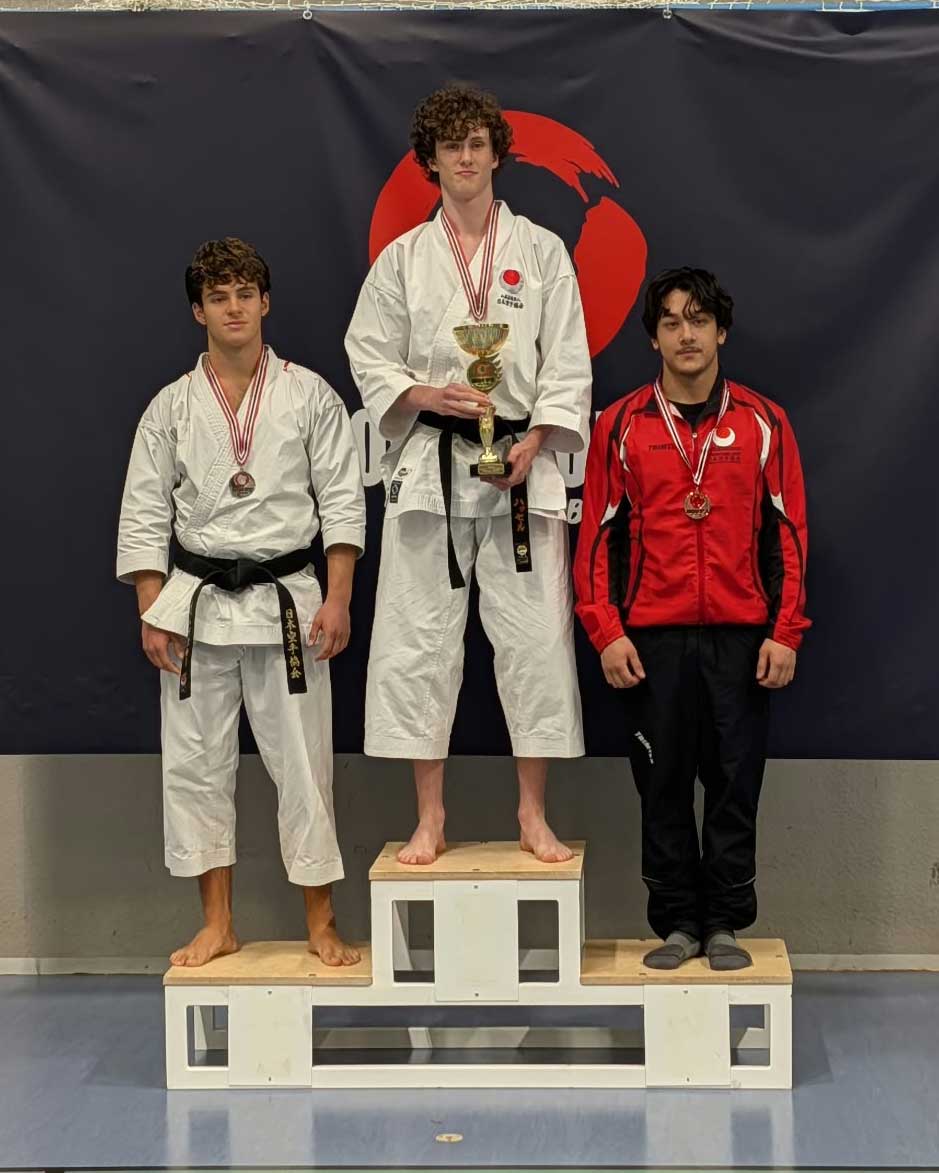
The character of the event was defined by the rules. JKA Shobu Ippon kumite is built around the idea of decisive, controlled technique. The goal is not simply to accumulate a large number of small scoring actions. Timing, distance, posture, control and the quality of the technique are central to how an exchange is judged.
That changes the rhythm of a match.
In a Shobu Ippon environment, one mistake can have major consequences, and one perfectly timed attack can decide a bout. Fighters therefore have to manage distance carefully and remain composed. Attacking without proper preparation can open the door for a counter, while hesitation can allow an opponent to take the initiative. The format rewards clarity and commitment, but also discipline.
At Nordic Open, Shobu Ippon was used across the kumite programme, including the youth, junior, senior and veteran categories. The main exception came in the finals of the 21–34 senior divisions, where the official rules switched to Shobu Sanbon. That gave the tournament’s showcase senior finals a longer competitive format while keeping the traditional scoring logic at the centre.
Team kumite was also included for athletes aged 18 and above. Teams consisted of three competitors with one reserve, adding a collective dimension to a competition otherwise dominated by individual categories.
Kata remains equally important
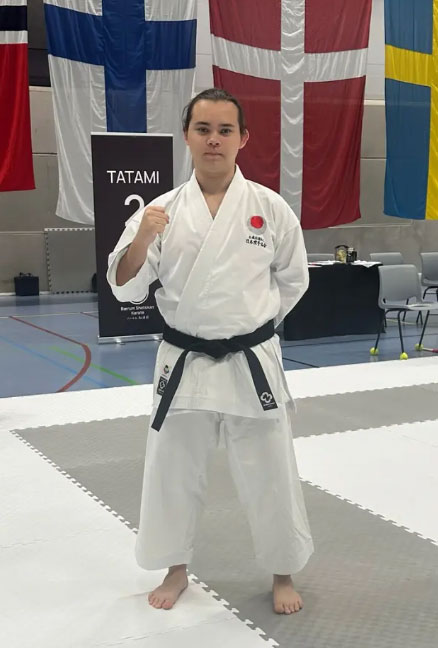
Nordic Open was never designed as a kumite-only tournament. Kata carried equal weight throughout the day, and the competition structure reflected the technical progression expected in traditional Shotokan karate.
The younger divisions began with Shitei kata, using a defined group of compulsory forms. For 12–15-year-olds, the later stages moved into Sentei kata, while the older classes progressed toward Tokui kata, allowing a broader selection of advanced forms.
The official list included the familiar Shotokan core of Bassai Dai, Kanku Dai, Enpi and Jion, together with advanced kata such as Sochin, Nijushiho, Chinte, Meikyo, Unsu, Gankaku, Gojushiho Sho and Gojushiho Dai.
Team kata was open from 16 years upward. The rules used a flag system before the final and a points system for the final stage, with teams required to demonstrate more than one kata. The design again reflects the tournament’s traditional emphasis: progression is not only about winning rounds but about demonstrating breadth and technical maturity.
Youth depth was one of the strongest features
The youth brackets were among the most striking parts of the 2026 draw.
Boys’ kata 16–17 years had 25 entries, making it the largest category of the day. It included athletes from Norway, Sweden and Denmark and brought together competitors from Bærum Shotokan, Fjellsiden, Bærum Taifun, Bjørgvin, Stord, Sandefjord, Lura, Marienlyst, Lund, Hammarö, Helsingborg and Hørsholm.
The 14–15 boys’ kata class also had a healthy field of 12, while the girls’ divisions showed solid numbers across 14–15, 16–17 and 18–20.
Several competitors were also able to enter the next age category in kata under the tournament rules. A 16–17-year-old, for example, could also compete in the 18–20 class, while an 18–20-year-old could step into the 21–34 senior category. That gives ambitious athletes a controlled way to test themselves at a higher level without removing the age structure entirely.
For the Nordic traditional karate scene, this kind of youth participation is particularly important. The long-term strength of competition is not determined only by the standard of the current senior champions. It also depends on whether teenagers are given enough meaningful competitive opportunities to stay motivated and continue developing.
Large junior categories give young karateka something that ordinary club training cannot fully reproduce: the pressure of performing a kata alone in front of referees, the uncertainty of facing an unfamiliar opponent and the requirement to produce good technique when the outcome actually matters.
Nordic Open provides exactly that kind of experience.
Senior divisions provided the showcase
The senior 21–34 categories were given special status in the schedule. Preliminary rounds and most medal contests ran during the main competition block, but the programme reserved the late afternoon for the senior showcase.
The official timetable scheduled the preliminary programme from 10:00 until 16:00, followed by finals and the award ceremony from 16:00 to 17:30. The closing session included the women’s and men’s 21–34 kata finals, together with the semi-finals and finals in senior kumite.
The senior fields were also among the deepest. Men’s kata 21–34 had 17 listed entries and men’s kumite 21–34 had 14. The women’s senior kata division had nine entries, while six were listed for kumite.
Among the Swedish and Danish names appearing in these brackets were athletes already familiar from other traditional karate events around the region. Their presence underlined the connection between Nordic Open and the wider Shobu Ippon calendar: the senior categories are increasingly becoming a place where leading club competitors can meet repeatedly across borders rather than only at occasional international championships.
The organisers also continued the Best Overall Athlete concept for the 21–34 category. The best female and male athlete were to be selected from combined performances in individual kata and kumite, with medal results in both disciplines carrying particular weight.
It is an interesting feature because it rewards a traditional ideal of the complete karateka. Modern competition frequently pushes athletes toward increasingly narrow specialisation, but an overall award based on both kata and kumite sends a different message. Technical form and fighting ability are treated as complementary parts of karate rather than completely separate sports.
Refereeing is part of the Nordic cooperation
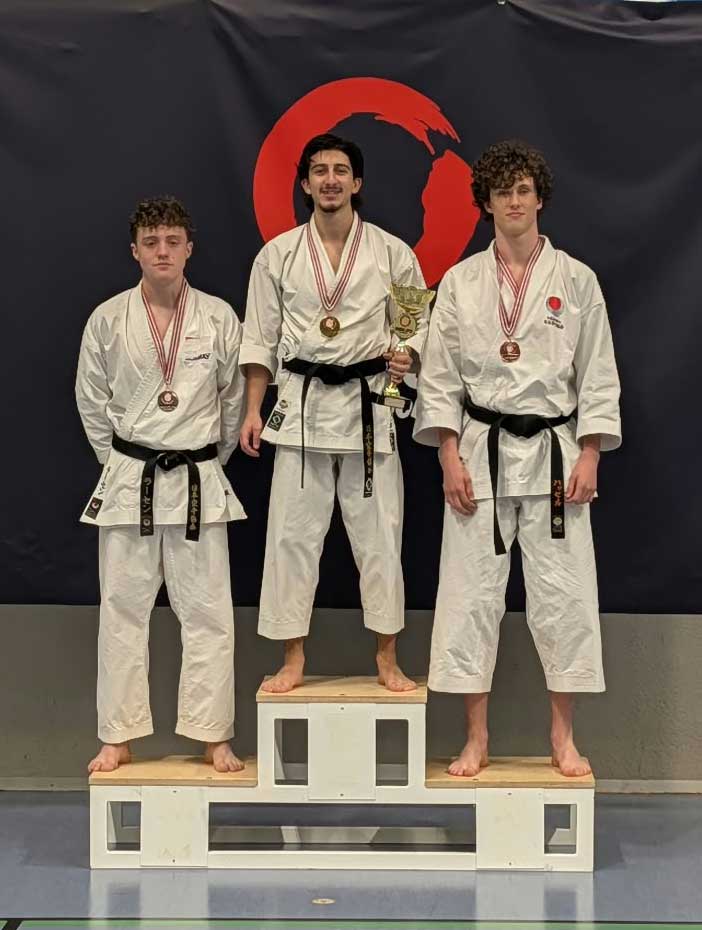
A tournament based on Shobu Ippon needs consistent refereeing. Because the format places such emphasis on the quality of a scoring technique, officials must interpret timing, distance, control and effectiveness in a similar way if competitors are to trust the result.
Nordic cooperation has therefore extended beyond athletes.
The invitation specified referee requirements and recognised that Norway, Sweden and Denmark use their own systems for selecting qualified officials. The referee meeting took place before competition on Saturday morning, creating a common starting point before the first bouts.
This follows the pattern seen at earlier Shobu Ippon events in the region, where referee education has been treated as part of the competition infrastructure rather than as an afterthought. That is particularly important when athletes come from different organisations. A shared ruleset only works if the officials applying it are well prepared.
Nordic cooperation among referees also has a long-term effect. Officials who repeatedly work together become more familiar with each other’s interpretations and procedures. That consistency benefits athletes, coaches and the competitions themselves.
Bærum provided a familiar Norwegian setting
Bærum Sports Park in Rud hosted the competition, with Bærum Shotokan Karate Club playing the local organiser role alongside JKA Norway.
The location placed the championship close to Oslo while giving the organisers access to a dedicated sports environment suited to a multi-tatami event. For travelling clubs, the invitation also set out hotel and transport information, including public transport connections from central Oslo.
The event was the second Nordic Open staged in Norway after the inaugural 2023 edition. Returning the tournament to Norway therefore had symbolic value as well as practical importance. It showed that the Nordic concept has survived beyond its launch and developed enough structure to rotate between host countries.
JKA Norway also entered the tournament from a strong organisational year. Earlier in 2026, Bergen hosted the JKA European Championships, bringing hundreds of athletes from across Europe to Norway. Nordic Open was a smaller event, but it represented another side of the same work: building competition opportunities at Nordic level and keeping traditional karate active between major international championships.
A stronger Nordic competition network
One of the most interesting aspects of Nordic Open is how it fits into an increasingly active traditional karate calendar.
Athletes appearing in Bærum had already had opportunities to compete at events such as the Shobu Ippon Tournament in Denmark, Swedish Shobu Ippon championships and domestic JKA competitions in Norway. In that sense, Nordic Open is no longer an isolated annual championship.
It is becoming a focal point within a network.
The benefits are obvious for developing athletes. Instead of facing the same small group of opponents repeatedly in domestic competition, they can travel relatively short distances and encounter different styles, tactics and technical interpretations.
For coaches, the wider circuit provides useful information about how athletes respond outside the familiarity of their own national environment. For referees it offers international experience without requiring travel to a European or world championship. For clubs it creates friendships and practical cooperation that can lead to training exchanges and future events.
That may explain why the Shobu Ippon concept has developed steadily in Scandinavia despite traditional karate being divided among several organisations.
The competition platform gives those organisations something concrete to cooperate around.
More than a medal tournament
The most important feature of Nordic Open may be what happens between the competitions.
Traditional karate in the Nordic countries is spread across many organisations, clubs and technical lineages. That can create strong local identities, but it can also limit the number of opponents available to athletes if every group competes only internally.
Nordic Open addresses that problem directly.
By keeping the event open to practitioners regardless of style or organisational affiliation, while still using a clearly defined JKA Shobu Ippon ruleset, the organisers create a common arena without demanding that clubs give up their own identity. A Swedish JKA athlete, a Danish Shobu Ippon competitor and a Norwegian Shotokan karateka can meet on the same tatami under rules that are known in advance.
The value of that approach grows over time. Young competitors begin to recognise each other from tournament to tournament. Coaches exchange ideas. Referees build working relationships. Clubs start travelling to each other’s events. What begins as a competition calendar gradually becomes a regional network.
Kampsportnews has followed that development in previous coverage of Shobu Ippon Danmark and other traditional karate events. The same themes repeatedly return: technical standards, volunteer work, referee development, respect between organisations and the importance of giving both young and experienced karateka reasons to remain active.
Nordic Open 2026 fitted directly into that picture.
The packed youth kata brackets showed that there is a new generation willing to compete. The senior divisions offered a serious sporting target. Veteran categories kept experienced practitioners involved. Team events brought club identity into the championship. And the cooperation between Norway, Sweden and Denmark gave the event a significance that went beyond the results of one Saturday.
Four editions into its development, Nordic Open is beginning to look less like an experiment and more like an established part of the Nordic traditional karate calendar.
That may ultimately be its greatest achievement. Medals decide who was best on the day, but the tournament itself is building something broader: a recurring arena where traditional karate can be tested, shared and strengthened across national and organisational borders.
Invitasjon til Nordic Open 19. september 2026 i Bærum – JKA Norway
Shobu Ippon Tournament March 2026 Tradition in Hørsholm
The story about Shobu Ippon Denmark | KAMPSPORTNEWS
Visa detta inlägg på Instagram
Visa detta inlägg på Instagram
Visa detta inlägg på Instagram
Visa detta inlägg på Instagram
Visa detta inlägg på Instagram
Visa detta inlägg på Instagram
Visa detta inlägg på Instagram