
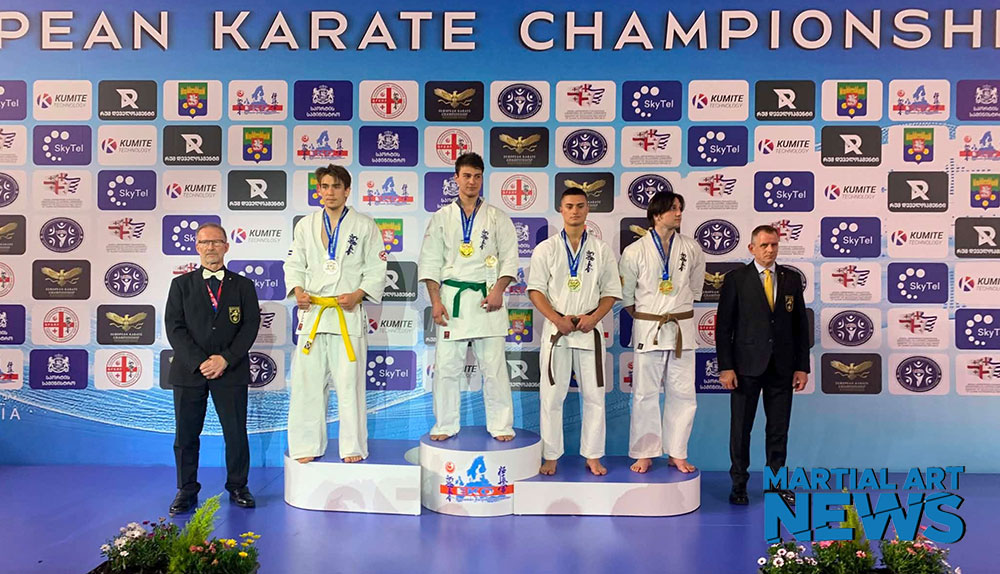

The 2026 European Karate Championships for Adults and Juniors J18 brought 444 competitors from 22 nations to Batumi, Georgia. For Sweden, the weekend ended with a long-awaited senior gold for Mirjam Björklund and a powerful junior silver for Wilhelm Pettersson.
Batumi became the centre of European Shinkyokushin karate during the weekend of 9–10 May, when the European Karate Championships 2026 for Adults and Juniors J18 were held in the Georgian coastal city by the Black Sea. The championship, organised under the European Karate Organization, gathered Europe’s top full-contact karate athletes in both kumite and kata, with senior and J18 categories on the tatami. According to the official event information, the championship was staged for juniors born in 2008 and 2009 as well as adult competitors, with kumite, individual kata and team kata on the programme.

For Sweden, the championship became one of those weekends that will be remembered well beyond the final bow. Mirjam Björklund finally secured the European gold that had eluded her for years. Wilhelm Pettersson added a Swedish junior silver in the heaviest J18 boys’ kumite class. Together, the medals gave Sweden a strong result in a championship that featured 444 participants from 22 nations, according to the Swedish Budo & Martial Arts Federation’s report from the event.
Björklund finally gets her European gold

Mirjam Björklund has long been one of the most established Swedish names in full-contact karate. She has previously stood on European podiums with silver and bronze, but the gold had remained just out of reach. In Batumi, that changed.
Competing in the women’s 54–59 kg kumite division, Björklund entered a field of 13 athletes. Her route to the title began with victory over Shanty Jacobs of Belgium. In the semi-final, she defeated Katarzyna Czernik of Poland, before facing Lithuania’s Justyna Vabalis in the final. Björklund won the final and became European champion.
It was a result with more weight than just another medal. For an athlete who has carried Swedish full-contact karate at international level for years, the gold in Batumi became a confirmation of persistence, development and competitive resilience. The Swedish Budo & Martial Arts Federation described it as a long-awaited European Championship gold after years of effort.
Björklund’s international level has been clear for some time. In 2024, Swedish Karate Kyokushinkai reported that she had been invited to WKO’s Karate Champions of Champions in Tokyo, a prestigious invitation event featuring 16 women and 16 men from WKO regions around the world. Europe had three women’s places at that event, with Björklund selected alongside Ivanka Popova of Bulgaria and Brigita Gustaityte of Lithuania.
That background makes the Batumi gold feel less like a surprise and more like the result of a long, disciplined process. Björklund has been close before. This time, she went all the way.
Wilhelm Pettersson takes silver in J18 +80 kg
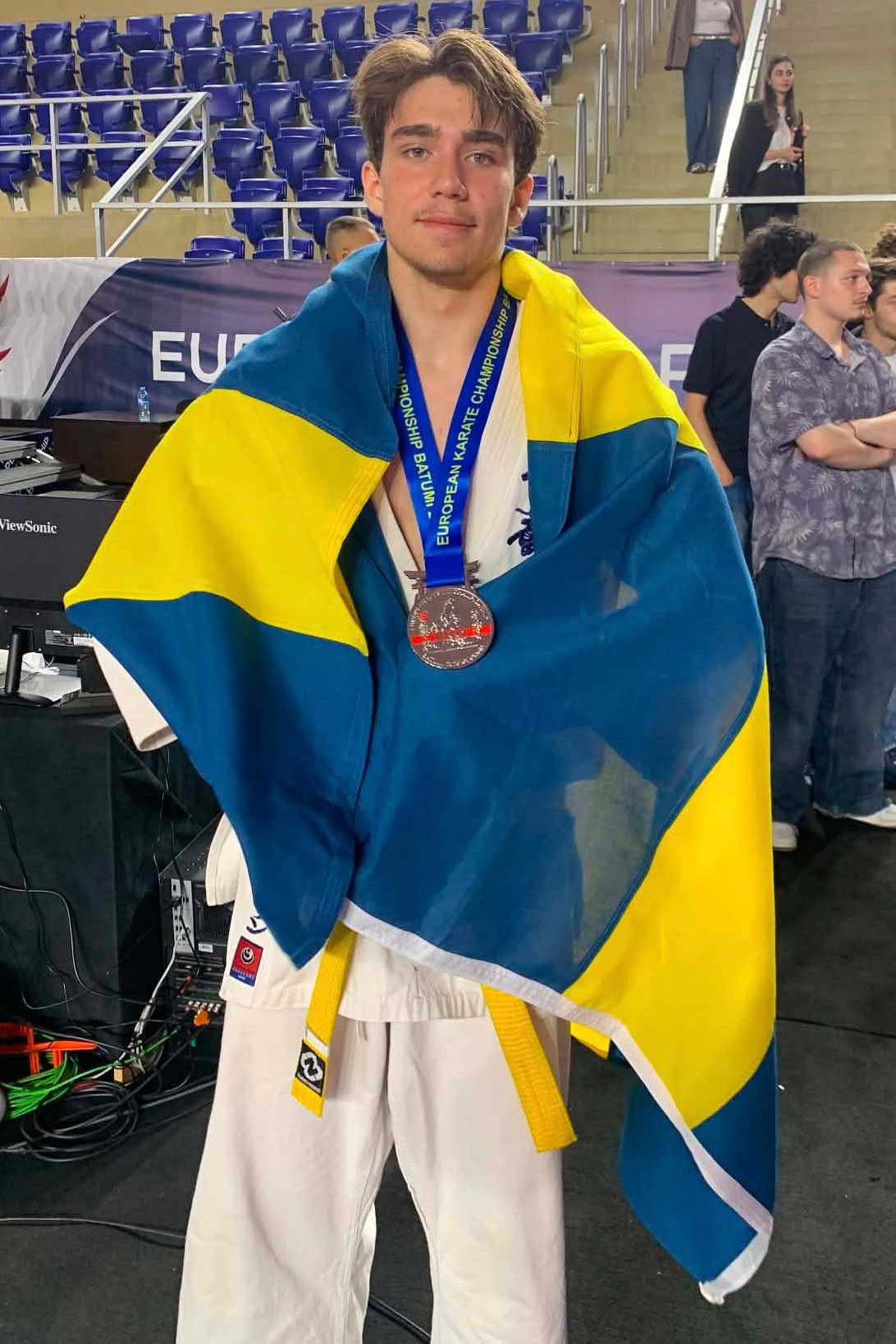
Sweden’s second medal came from the junior side, where Wilhelm Pettersson claimed silver in the J18 boys +80 kg category. The result was also celebrated by Örebro Kyokushin Karate / Budohuset, where Pettersson’s performance was described as a very strong second place in the heaviest junior class.
Pettersson’s silver gave Sweden a medal in one of the physically toughest junior categories of the championship. The J18 division is reserved for athletes born in 2008 and 2009, and the official event information listed boys’ kumite classes from -60 kg up to +80 kg.
Örebro Kyokushin had extra reason to follow the event closely. Ahead of the championship, the club highlighted that Wilhelm Pettersson and Sensei Morgan Nordin would represent Sweden in Batumi, with Pettersson competing in kumite and Nordin in kata. Linus accompanied them as coach, according to the club’s own social media update.
For a junior athlete, a European Championship silver is not only a medal but also a signal. It places Pettersson among the most promising heavy junior competitors in Europe and adds another name to watch in Swedish Kyokushin.
Sweden’s team had been shaped through national selection
The Swedish senior squad for Batumi had been presented earlier in the year after a national selection process. Swedish Karate Kyokushinkai reported that more than 20 fighters gathered at Stockholm Kyokushin Karate on 7 February for the year’s first squad session for U21 and senior athletes, where training, tactics and competitive readiness were tested. The selected senior kumite team included Ali Hayder, Mirjam Björklund, Sebastian Eriksson, Agnes Hellqvist, Alireza Nazari and Giulia Sae Rossi.

In that announcement, the national team framed the road to Georgia as a mission to represent not only the individual athlete or club, but Swedish Kyokushin as a whole. The phrasing proved fitting. Once the championship was over, Sweden had both a senior European champion and a junior silver medallist to celebrate.
Batumi hosted Europe’s Shinkyokushin elite
The championship took place at Batumi Sports Palace, located on Lado Asatiani Street. The official event information lists the venue as opened in June 2018 with a capacity of 3,000 spectators.

The competition format covered both adult and junior divisions. In the adult kumite categories, men competed across five weight classes: -60 kg, 60–70 kg, 70–80 kg, 80–90 kg and +90 kg. Women competed in -50 kg, 50–54 kg, 54–59 kg, 59–65 kg and +65 kg. Kata was also held for men, women and teams. The championship also served as the first selection event for the 2027 World Championship in kata for men and women, with a second selection scheduled for Latvia in October 2026.
The J18 programme included kumite for boys and girls, as well as kata and team kata. Each country was allowed two participants per category in kumite and kata, and two teams per country in team kata. The host country was granted one additional participant in each category.
As is expected at this level, the championship also included anti-doping measures. The official event document stated that anti-doping tests would be conducted by the Georgian Anti-Doping Agency in accordance with WADA protocol.
Kata medals underline the strength of Eastern Europe

While Sweden’s main medal success came in kumite, the kata events also gave a clear picture of the competitive balance in European Shinkyokushin.
According to results shared by the European Karate Organization, Carla Gallati of Switzerland won the senior women’s kata title ahead of Anastasiia Pryshliak of Ukraine, with Diana Mačiūtė and Raminta Makackaitė of Lithuania taking bronze. In senior men’s kata, Cristian Boldut of Romania won gold, Nikolaj Lunn Jensen of Denmark took silver, and Lithuania’s Matas Sasnauskas and Matas Jonauskas claimed bronze.
In the junior kata divisions, Lithuania and Ukraine were particularly strong. Karolina Radžiūnaitė of Lithuania won junior girls kata, ahead of Romania’s Crina Bianca Stase, with Lena Małysz of Poland and Dana Zin of Ukraine taking bronze. In junior boys kata, Ukraine took both gold and silver through Roman Markiv and Nazar Tsiupka, while Rares Urda of Romania and Roland Terbocs of Hungary finished third.
The team kata results also showed Lithuanian depth. Lithuania won junior team mix kata and senior team mix kata, while Romania and Ukraine also featured prominently on the podiums. The results reflected a high technical level across the kata programme, where precision, rhythm and team coordination were decisive.


A championship with both tradition and future

Kyokushin and Shinkyokushin championships carry a particular kind of atmosphere. The sport’s full-contact nature makes kumite physically demanding, but the etiquette, discipline and formality around the tatami remain central. The official event regulations in Batumi reflected that balance: strict participation requirements, medical control, protective equipment rules and clear category structures were combined with a championship environment built around international exchange.
For the juniors, Batumi was a chance to experience a major continental event early in their careers. For the adults, it was another step in the ongoing European hierarchy, where each result affects rankings, selection and reputation.
For Sweden, the story was especially clear. Mirjam Björklund’s gold was a personal breakthrough on the European stage. Wilhelm Pettersson’s silver showed the potential of the next generation. Together, they gave Swedish Kyokushin a weekend of both reward and promise.
Sweden returns with momentum

The Swedish team travelled to Georgia with hopes, but European Championships in full-contact karate rarely allow easy predictions. Draws, styles, physical pressure and small margins can quickly change a tournament. That is why Björklund’s gold and Pettersson’s silver stand out.
Björklund did not just win a medal; she completed a journey. After previous silver and bronze medals, she finally stood highest on the podium. Pettersson, meanwhile, delivered a junior result that suggests Swedish Kyokushin has more to build on in the coming years.
When the tatami in Batumi was cleared and the championship weekend closed, Sweden had two strong reasons to look back with pride: one long-awaited European champion and one rising junior silver medallist.
Osu.
2026 European Karate Championship for Adults and Juniors J18 KumiteTechnology
EM-guld i shinkyokushin för Mirjam Björklund – Svenska Budo & Kampsportsförbundet
European Kyokushin | EKO – European Kyokushin
European Karate Organization Facebook
Nordic Open Kyokushin 2026 in Stenungsund – Sweden


Visa detta inlägg på Instagram
Visa detta inlägg på Instagram
Visa detta inlägg på Instagram
Visa detta inlägg på Instagram
Visa detta inlägg på Instagram
Visa detta inlägg på Instagram
Visa detta inlägg på Instagram
Visa detta inlägg på Instagram
Visa detta inlägg på Instagram
Visa detta inlägg på Instagram
Visa detta inlägg på Instagram
Visa detta inlägg på Instagram