

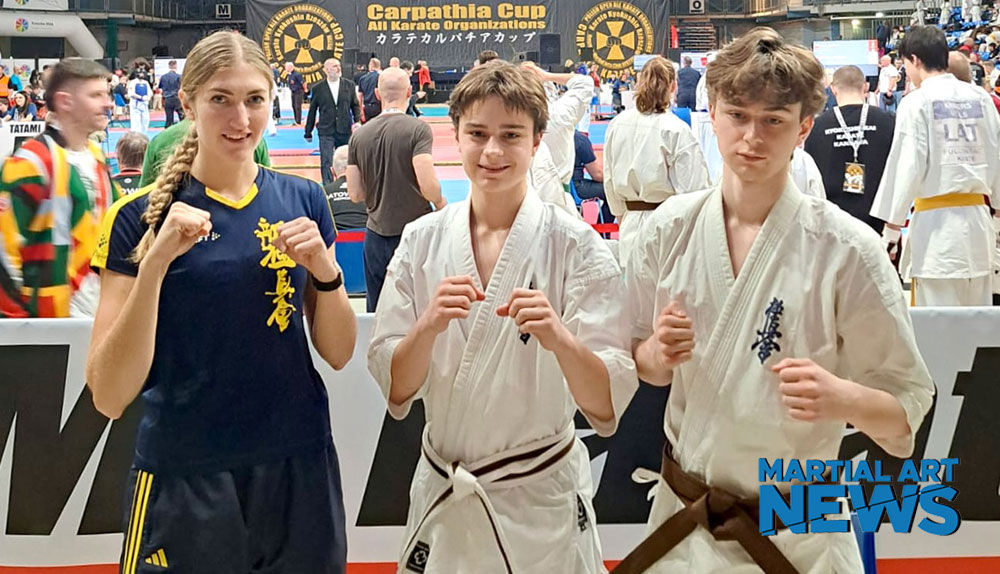

When you talk about the early-season proving grounds in full-contact karate, Carpathia Karate Cup sits high on the list. On January 24, 2026, the tournament returned to Rzeszów, Poland, filling the “PODPROMIE” Sports Hall with the kind of atmosphere that only big Kyokushin events create—short warm-ups, long queues at verification, coaches shouting last-second adjustments, and fighters learning in real time what works when the level goes up another notch.

This year’s edition gathered over 700 competitors from 12 countries, making it one of the largest Kyokushin tournaments in Europe in terms of participation and international mix.
Organized by Rzeszów Martial Arts Club SYSTEM—with the event team led by Paweł Możdżeń and Janusz Wiśniewski—Carpathia Cup has built a reputation for scale, strong brackets, and an unforgiving pace where small mistakes get punished fast.
Below is a deep look at how the weekend unfolded, and—most importantly—how the highlighted clubs and their athletes performed, with each club’s results and standout moments given their own space.
The framework: verification, six tatami, and a full day of kata and kumite
Carpathia Cup is built like a marathon with sprints inside it.
The schedule began with verification on Friday, January 23, at the organizer’s dojo facility (RKSW SYSTEM / “NOWY ŚWIAT”), followed by competition day on Saturday at PODPROMIE.
On Saturday, the day ran from early kata verification through kata competition (09:00–11:30), the opening ceremony, and then kumite (12:00–18:00) before the awards ceremony in the early evening.
The rule structure reflected a modern Kyokushin tournament trying to handle both huge youth fields and senior full-contact classes:
-
Kata: age-divided categories, with eliminations that move into a top-8 bracket and then flags (and rules preventing repeating the same kata in later rounds).
-
Kumite: primarily knockout, with round-robin used if a category has three athletes, and category merging possible when numbers are too low.
-
Contact levels by age: Light Contact (U8–U10), Semi Contact (U12–U14), All Kick (U16–U18), and Full Contact for Seniors/U21 and Masters—each with specific equipment and technique limits.
Those details matter, because many of the stories coming out of the Scandinavian teams in Rzeszów weren’t just about medals. They were about navigating a tournament where formats shift, rulesets vary by age, and judging dynamics can change the outcome of a close bout.

Host club spotlight: Rzeszów Martial Arts Club SYSTEM and why Carpathia keeps growing
Every big tournament needs a club that can handle logistics without losing the spirit of the sport. Rzeszów Martial Arts Club SYSTEM continues to build Carpathia Cup into a reliable European meeting point: clear verification windows, a venue built for multi-tatami flow, and a competition day that—despite delays that sometimes happen at large events—still delivers a full program of kata and kumite in one day.
Carpathia’s growth also reflects something deeper in European Kyokushin: athletes are traveling more, clubs are treating international events as development checkpoints, and youth categories are now so deep that simply reaching quarterfinals can mean defeating a strong, nationally ranked fighter from another country.
That context sets the stage for how the Scandinavian clubs approached the weekend: not as tourists, but as competitors coming to measure themselves.

Uppsala Kyokushin Karate: Elliot & Caspian Abrahamsson Carnrot, and Ella Elvander’s fourth place in a stacked kata field
Sweden’s presence in Rzeszów included athletes from Uppsala Kyokushin Karate, and the club report captured the reality of competing in large international brackets: you can perform well, stay composed, even push the pace—yet still be one decision away from advancement.
Elliot Abrahamsson Carnrot (U18 −65 kg): a tactical wall in the quarterfinal
Competing in U18 −65 kg (a category with 10 participants), Elliot Abrahamsson Carnrot reached the quarterfinals and faced Poland’s Adrian Rzonca. According to the Swedish report, Rzonca used height and reach effectively—high, hard punching to stop entries and inside low kicks to disrupt Elliot’s movement.
Elliot, however, didn’t fold. Despite having dealt with a prolonged illness recently, he pushed forward and drove the action, creating multiple head-kick attempts that, under other rulesets, might have been rewarded. The bout still ended 3–0 by judges’ decision after the first round, meaning no extension was granted.
Result: Quarterfinal loss (decision).
Caspian Abrahamsson Carnrot (U14 −65 kg): pressure, low kicks, and a close decision
In U14 −65 kg (with 7 participants), Caspian Abrahamsson Carnrot met Lithuania’s Dominik Akanovic in the quarterfinal. The opponent started with high-volume punching, but Caspian settled quickly, stayed with his plan, and tried to score with kicks while refusing to give ground late in the bout.
The report emphasizes Caspian’s technical variety—especially compared with an opponent leaning heavily on punches—but once again the decision went the other way, 3–0, in what was described as a very even match.
Result: Quarterfinal loss (decision).

Ella Elvander (Women’s Kata): fourth place after a chaotic bracket and a champion-level opponent
Ella Elvander entered a women’s kata category with 18 competitors, and the day started with delays and an elimination system that caused confusion. In the elimination round, seniors performed Gekisai Sho, and Ella’s score placed her among three athletes tied on 18.7, sharing fifth in that stage. A software issue reportedly followed, judges discussed how to resolve it, and the division proceeded after a long interruption and the opening ceremony break.
In the quarterfinal, using flags, Ella faced Ukraine’s Anastasiia Pryshliak. They drew Saiha, and Pryshliak advanced—and later won the entire class—leaving Ella in fourth place overall.
Result: 4th place (Women’s Kata).
For Uppsala, the takeaway is easy to respect: the athletes weren’t blown out. They were close in tough fights, and Ella placed just off the podium in a deep field—exactly the kind of experience that sharpens a team heading into the rest of the season.
Örebro Kyokushin: Morgan Nordin’s kata run and Gustav’s bronze in kumite

Örebro Kyokushin also had athletes on the floor in Rzeszów, and their presence connected directly with the wider Swedish group—sharing warm-up space, dealing with format shifts, and facing the reality that “one more round” can be the difference between a medal and a learning weekend.
Morgan Nordin: strong opening, then a tight quarterfinal exit
Kata began with an initial round that was judged by points, then shifted into flags—with the quarterfinal using a drawn “B-kata” format. Morgan opened well with Gekisai Sho, advanced to the quarterfinal, and then drew Tsuki no kata, where the match was described as close but ended in a loss—placing him just outside medal positions.
Result: Quarterfinal exit / outside podium (Kata).
Gustav: bronze after a hard fight and an extension
In kumite, Gustav (Örebro Kyokushin) fought a Lithuanian opponent and pushed the first round to an extension after a competitive opening. In the extra time, the opponent’s experience made the difference, and Gustav struggled to land cleanly despite attempts that included knees and head kicks that came close. The Swedish reporting still credits the performance as a strong showing that resulted in a bronze medal.
Result: Bronze medal (Kumite).
That bronze matters because it reflects the typical Carpathia reality: medals often come through narrow margins, not dominance. You earn them by surviving the pace and staying functional when fatigue hits.
Seishin Kyokushin Karate (Linköping): Eric in kata top-8, and Giulia Sae Rossi takes silver in a senior full-contact division

For Seishin Kyokushin Karate, Carpathia Cup 2026 was the kind of weekend that justifies traveling: a real test in kata, and a senior kumite run that ended with a silver medal against proven international opposition.
Giulia: 9th in kata by a tenth of a point
Giulia opened in kata and narrowly missed the top-8 by 0.1 points, landing 9th after a well-executed Gekisai Sho in a field described as extremely experienced.
Result: 9th place (Kata).
Eric: into the top-8, then out in the quarters for a shared 5th
Eric held composure through the initial kata scoring round, reached the top-8, and advanced into the quarterfinal bracket. There he faced Poland’s Wojciech Hajduk, drew Gekisai Dai, and delivered a solid performance—but not enough to advance—finishing shared 5th.
Result: Shared 5th (Kata).
Giulia Sae Rossi: silver in Senior Women’s Full Contact (−55 kg) after a round-robin war
Giulia’s biggest impact came in kumite, competing in Senior Women’s Full Contact at −55 kg (she entered that class because there was no −50 available). The category ran as round robin, meaning everyone fought everyone—no easy pacing, no hiding, and no “one-and-done” reset.
Her listed opposition included Lithuania’s Rasa Klemenskaitė (noted as having competed at the European Championship in Hungary at −55 kg) and Ukraine’s Anastasiia Nehrai (described as a Ukrainian national champion and U21 European silver medalist, but naturally closer in size to Giulia due to her −50 background).
After Rasa defeated Anastasiia in their meeting, Giulia fought Anastasiia at a high tempo, then accelerated late and dominated strongly enough to earn all five flags after the first round—turning the final bout into a de-facto title fight.
In the decisive match against Rasa, Giulia kept the pressure but Rasa’s distance management—knees, mae geri, and higher kicks from range—appeared to sway judges, and Giulia finished with silver. A separate competition post also lists the final as Rasa Klemenskaite (Lithuania) vs Giulia Sae Rossi (Sweden).
Result: Silver medal (Senior Women’s Full Contact −55 kg).
Silver at Carpathia doesn’t just look good on paper. It signals that you can solve problems under pressure against athletes who have already shown themselves at major championships.

International highlights: the finals that underline Carpathia’s level
One reason Carpathia Cup carries weight is that senior brackets frequently include athletes from different Kyokushin organizations and countries—making for “styles within the style” clashes.
A few examples from the event’s reported finals and featured match-ups:
-
Senior Women −55 kg final: Rasa Klemenskaite (Lithuania) vs Giulia Sae Rossi (Sweden).
-
Senior Men −70 kg final: Kuba Pałaszewski (Poland) vs Javier Zamora (Spain).
-
Senior Men −80 kg featured final listing: Alireza Nazari (Sweden) vs Carles Vert (Spain) (noted as a featured final pairing).
Even without publishing every bracket outcome, these names and international pairings tell you what kind of tournament Rzeszów hosted: one where Scandinavian fighters aren’t just meeting regional opponents—they’re stepping into truly European-level fights.

Lidköping Kyokushin Karate: Ali Secures Silver in Poland
Lidköping Kyokushin Karate was also represented at the Carpathia Karate Cup 2026, where Ali delivered a strong performance and returned home with a silver medal after a demanding day of competition. Fighting in a tough international field, Ali showed both resilience and composure, advancing through his matches with determined pressure and solid technique. The final proved highly competitive, with small margins deciding the outcome, but the silver medal stands as a clear confirmation of Ali’s level and development. His result adds to a successful Swedish showing in Rzeszów and underlines Lidköping Kyokushin’s continued progress on the international Kyokushin scene.
The rulebook reality: why “close” at Carpathia still means something

A lot of readers look at results and see only medals. But Carpathia Cup is a tournament where:
-
Youth divisions are protected by strict equipment rules and technique limits (especially for jodan techniques in Light Contact and Semi Contact).
-
Older divisions allow more tools, more intensity, and greater scoring complexity—and judging can be influenced by range, balance, and how cleanly techniques land.
-
Decision-based outcomes are common, meaning tactical control and perceived dominance can matter as much as volume.
That context is exactly why Elliot’s and Caspian’s quarterfinal losses are still meaningful. Those were matches where Swedish athletes were not outclassed—they were edged in decision dynamics against opponents who likely fight this environment often.
Closing thoughts: medals, margins, and momentum into the 2026 season
Carpathia Karate Cup 2026 delivered what it always promises: a huge field, international pressure, and the kind of competitive density where a “good performance” can still end in a quarterfinal loss—while a medal often requires surviving fatigue, judging swings, and unfamiliar pacing.
From a Scandinavian perspective, the weekend produced clear highlights:
-
Uppsala Kyokushin Karate: Ella Elvander 4th in Women’s Kata, plus two high-level quarterfinal bouts for Elliot and Caspian Abrahamsson Carnrot.
-
Örebro Kyokushin: Gustav bronze in kumite, and Morgan Nordin competitive in kata through to the quarters.
-
Seishin Kyokushin Karate: Giulia Sae Rossi silver in senior full-contact −55, and Eric top-8 / shared 5th in kata after advancing into the bracket.
And on the organizer side, Rzeszów Martial Arts Club SYSTEM once again proved why Carpathia remains a European magnet: the infrastructure and scale that allow a 700+ athlete weekend to happen at all.
Photo: Photo: Swedish Karate Kyokushinkai @swedish_karate_kyokushinkai.
NLT – Ali fixade ett vasst silver i Polen
NKP – Linnea tog mycket stryk – gav ännu mer tillbaka: ”En väldigt stor framgång”
Rapport från Carpathia – Swedish Karate Kyokushinkai
Seishin Kyokushin Karate på Carpathia Cup 2026 / Seishin Kyokushin Karate
Wielkie święto karate na Podpromiu – w sobotę odbył się turniej Carpathia Cup | Nowiny
Nordic Open Kyokushin 2026 in Stenungsund – Sweden
Örebro Kyokushin Karate // Budohuset – Morgan rapporterar
Örebro Kyokushin Karate // Budohuset – Gunilla rapporterar
Örebro Kyokushin Karate // Budohuset – Grattis Julia
Visa detta inlägg på Instagram
Visa detta inlägg på Instagram
Visa detta inlägg på Instagram