
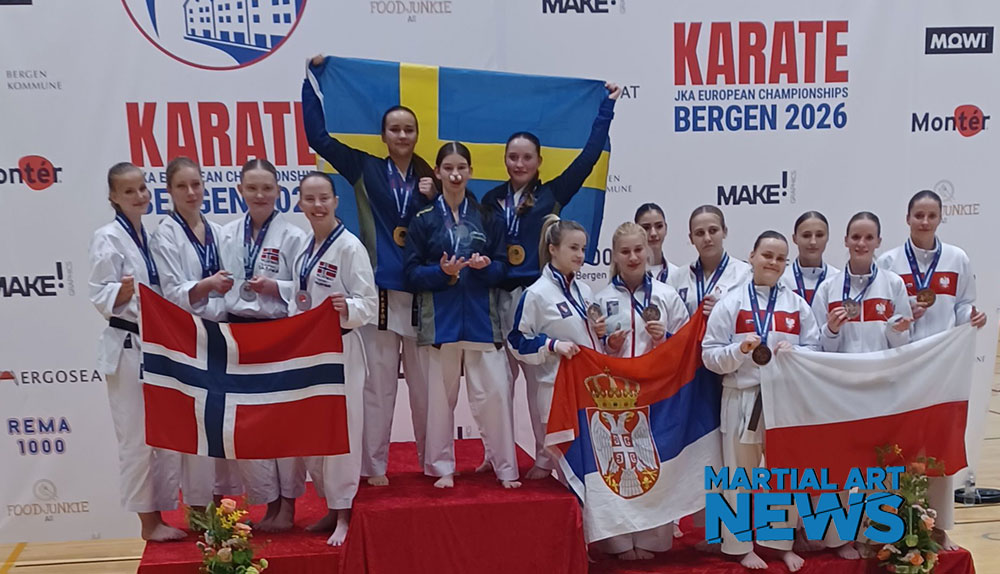

Swedish juniors deliver a golden first day in Norway, while host nation Norway celebrates Grand Champion history at a strong JKA European Championships
The JKA European Karate Championships 2026 in Bergen became one of the most memorable weekends of the year for Scandinavian Shotokan karate. Over two intense competition days, athletes from across Europe gathered at Haukelandshallen in Norway for a championship that combined tradition, pressure, and a high level of technical karate. The official championship site listed the event for 8–9 May 2026 in Bergen, with Haukelandshallen as the venue.
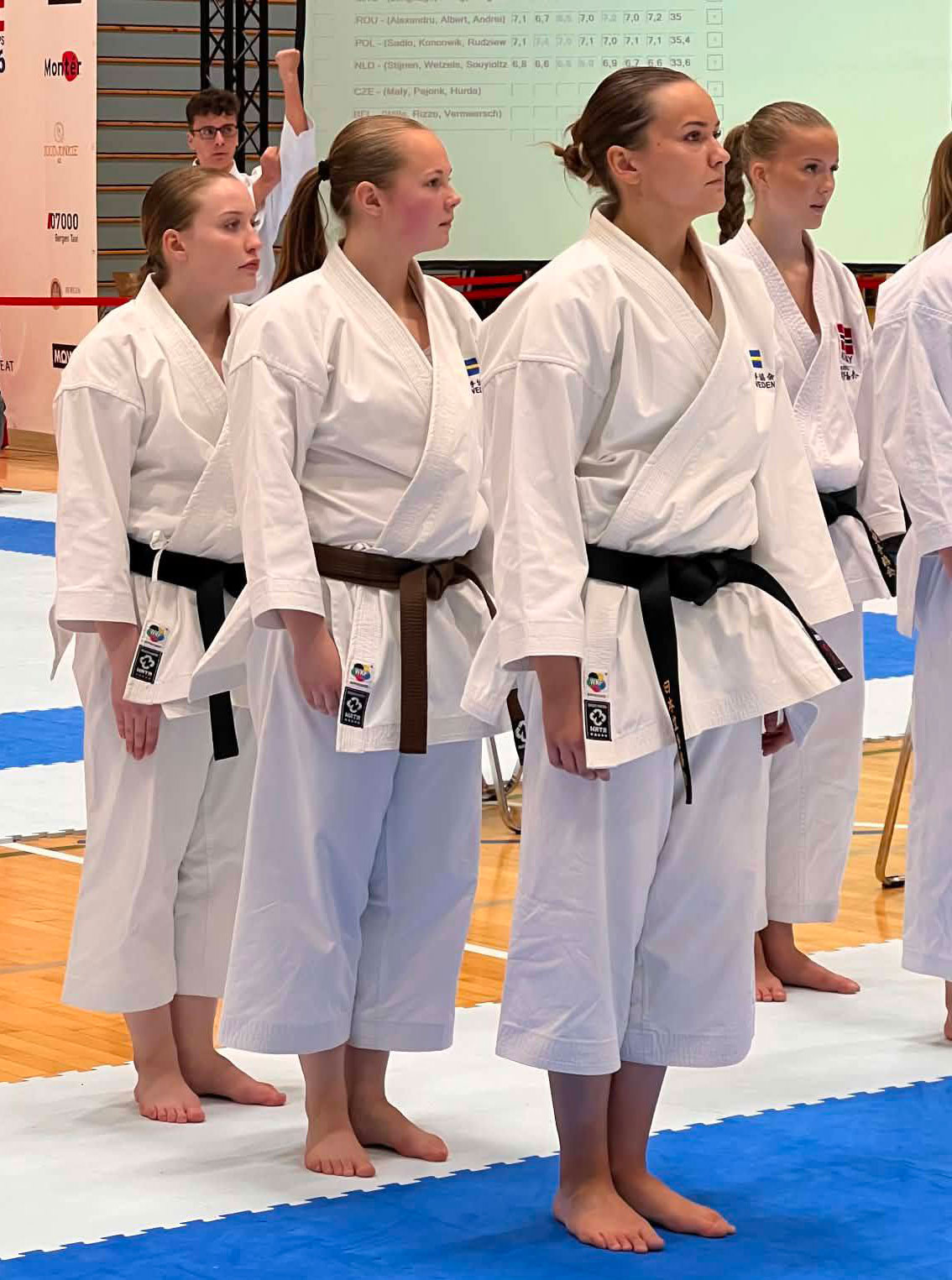
For Sweden, the championship ended with a strong medal haul: three gold medals, two silver medals and four bronze medals, according to JKA Sweden’s own summary. The result was built largely on a spectacular opening day from the junior squad, where Sweden’s young athletes showed both quality and depth in kata and kumite.
The event brought together 23 countries and close to 400 participants. Local Norwegian reporting stated that 383 athletes competed in Bergen, supported by more than 100 volunteers who contributed over 3,000 hours to the organisation of the event. It was a championship that clearly meant a great deal not only to the competitors, but also to the Norwegian karate community, with JKA Norway and local clubs helping to stage an event that carried both European prestige and a strong Nordic identity.
Swedish junior women dominate kata
Sweden’s best moment came early. In junior women’s individual kata, the Swedish team achieved a full podium sweep. Alma Roth from Ystad Karateklubb won gold, Mathilda Johansson, also from Ystad Karateklubb, took silver, and Ella Elezovic from Shotokan Karate Helsingborg secured bronze.
A clean sweep in an individual European kata category is not something that happens by accident. It requires not only one outstanding athlete, but a full national environment capable of producing several competitors at the same level. In Bergen, the Swedish junior women showed exactly that.
Kata at this level is unforgiving. The margins are small, the judging is strict, and the athletes must combine power, rhythm, precision, stability, breathing, timing and fighting spirit. For Sweden to take all three medals in the same category says a great deal about the current standard of the Swedish junior kata programme.
The result also gave the Swedish team momentum. Once Roth, Johansson and Elezovic had occupied the entire podium, the rest of the day became a statement: Sweden had not travelled to Bergen merely to participate. The team had come prepared to fight for titles.
Team kata gold confirms Swedish depth
The same trio then continued Sweden’s golden run in junior women’s team kata. Alma Roth, Mathilda Johansson and Ella Elezovic combined for another gold medal, underlining that their individual success was not isolated.
Team kata is often one of the clearest measures of structure within a national squad. It is not enough for each athlete to be technically strong. The team must breathe together, move together and express the same rhythm. Every hesitation becomes visible. Every difference in posture, timing or direction can separate gold from silver.
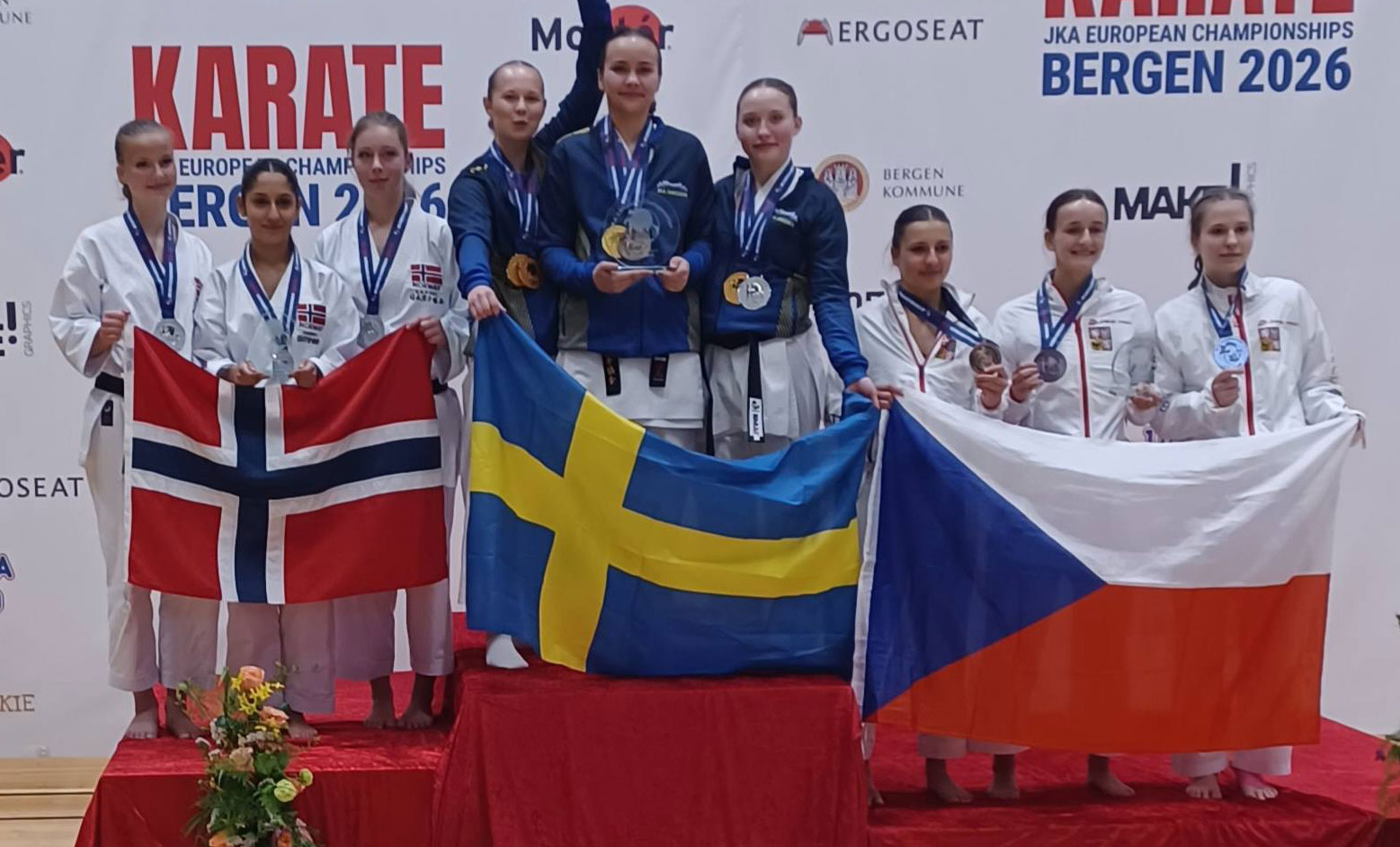
In that sense, Sweden’s junior women did more than win. They showed that the country has a coordinated and disciplined kata generation coming through. The win also strengthened the role of Ystad Karateklubb and Shotokan Karate Helsingborg in the Swedish medal story, with all three athletes already having proved themselves individually before returning to the tatami as a unit.
For Swedish JKA karate, this was one of the clearest takeaways from Bergen: the junior women are not just talented. They are already capable of carrying European championship pressure.
Kumite gold for the Swedish junior women
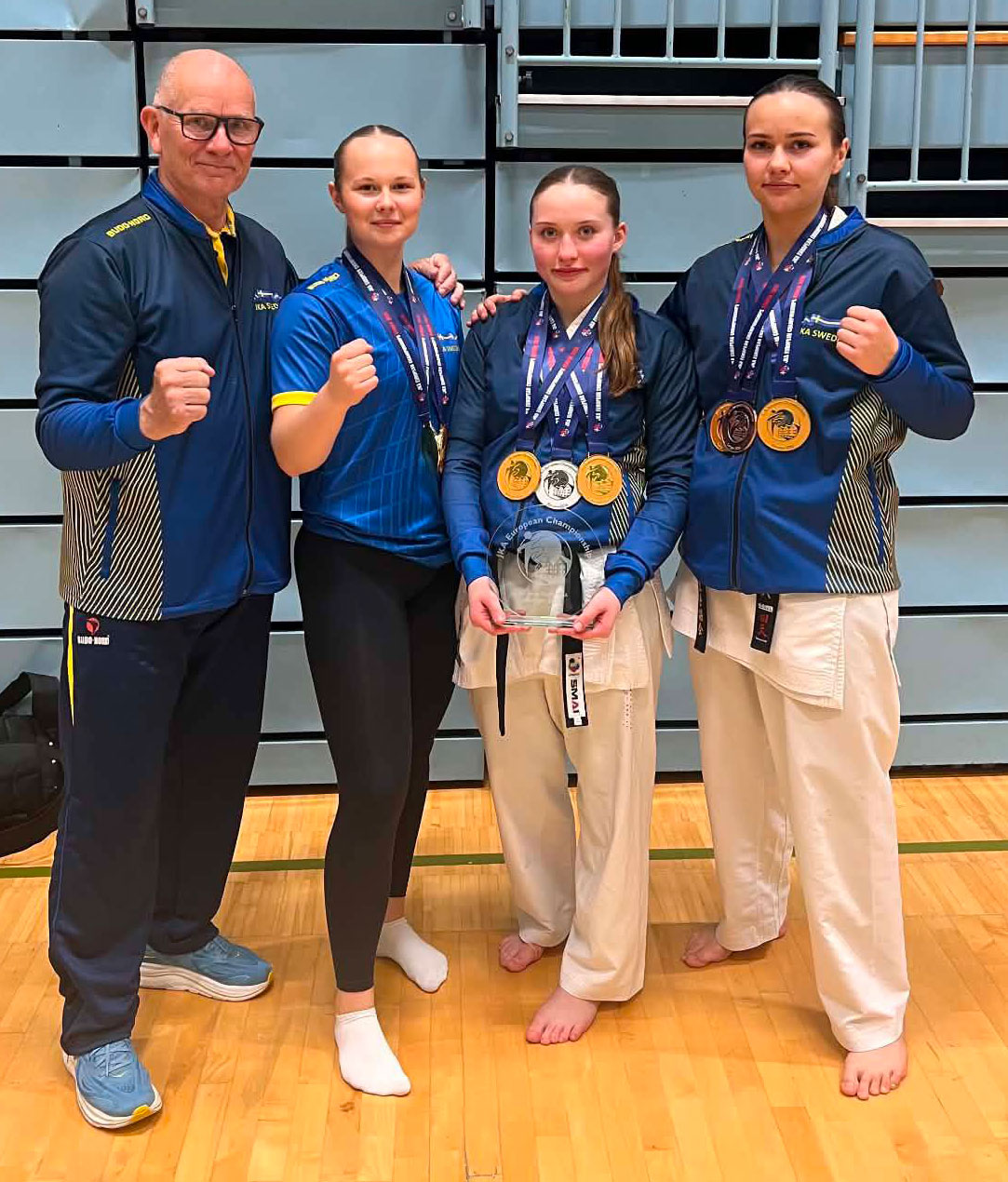
Sweden’s third gold medal came in junior women’s team kumite. The Swedish team consisted of Aleksandra Tesic from GAK Enighet, Mathilda Johansson from Ystad Karateklubb and Ella Elezovic from Shotokan Karate Helsingborg.
This was another important result because it showed that the Swedish medal success was not limited to kata. The same championship day produced Swedish gold in both the formal and fighting disciplines of JKA karate.
Team kumite has its own drama. It is tactical, physical and emotional. A team must balance aggression with control, confidence with patience, and individual fighting style with collective responsibility. Each match can shift the momentum of a final. Each point can change the mood on the mat.
According to the official results preview indexed from the championship results document, Sweden defeated Norway in junior female team kumite, with the Swedish team listed as Tesic, Elezovic and Johansson. That final also became a talking point in Norwegian media, where the home team’s strong run to silver was covered locally.
For Sweden, the gold was another sign that this junior group can perform under pressure. For Norway, the silver was also part of a broader home championship that delivered several major highlights.
Toffik Boughiout adds bronze in junior men’s kumite
Sweden’s junior medal haul was completed by Toffik Boughiout of GAK Enighet, who won bronze in junior men’s individual kumite.
His result added another dimension to Sweden’s first day. While the junior women produced the biggest headlines through their gold medals and podium sweep, Boughiout’s bronze showed that the Swedish men’s side also had competitive strength in the kumite categories.
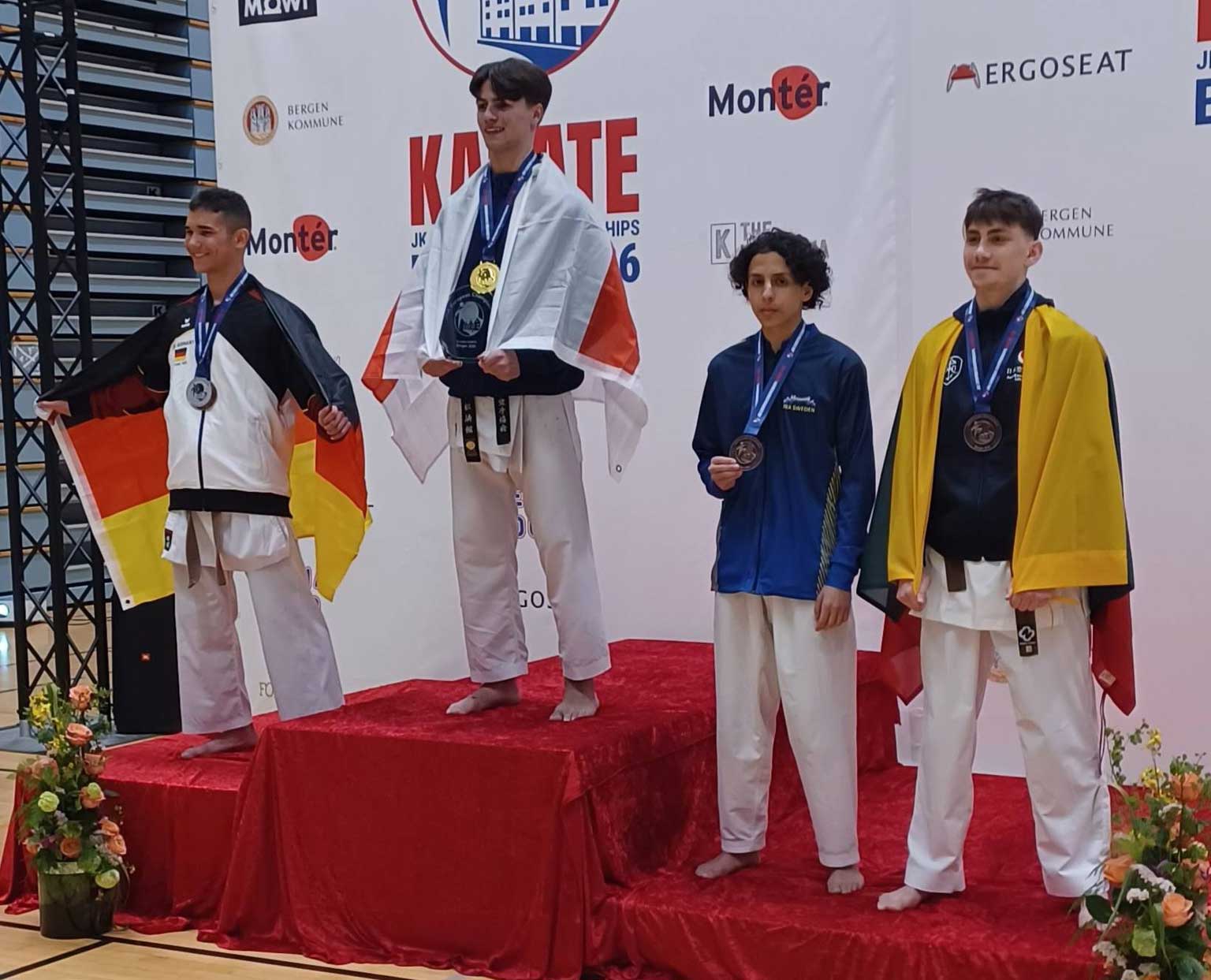
Bronze medals at European level can sometimes be described too casually. In reality, they often require several demanding bouts, recovery after setbacks, and the ability to win when the final is no longer available but the podium still is. Boughiout’s bronze therefore deserves a clear place in the Swedish story from Bergen.
By the end of the opening competition day, Sweden had collected three gold medals, two silver medals and two bronze medals. It was a junior performance that gave the Swedish delegation one of its strongest starts in recent JKA European competition.
Seniors follow with two bronze medals
On the second day, the senior and adult categories entered the spotlight. Sweden could not quite match the golden rhythm of the juniors, but still added two important bronze medals.
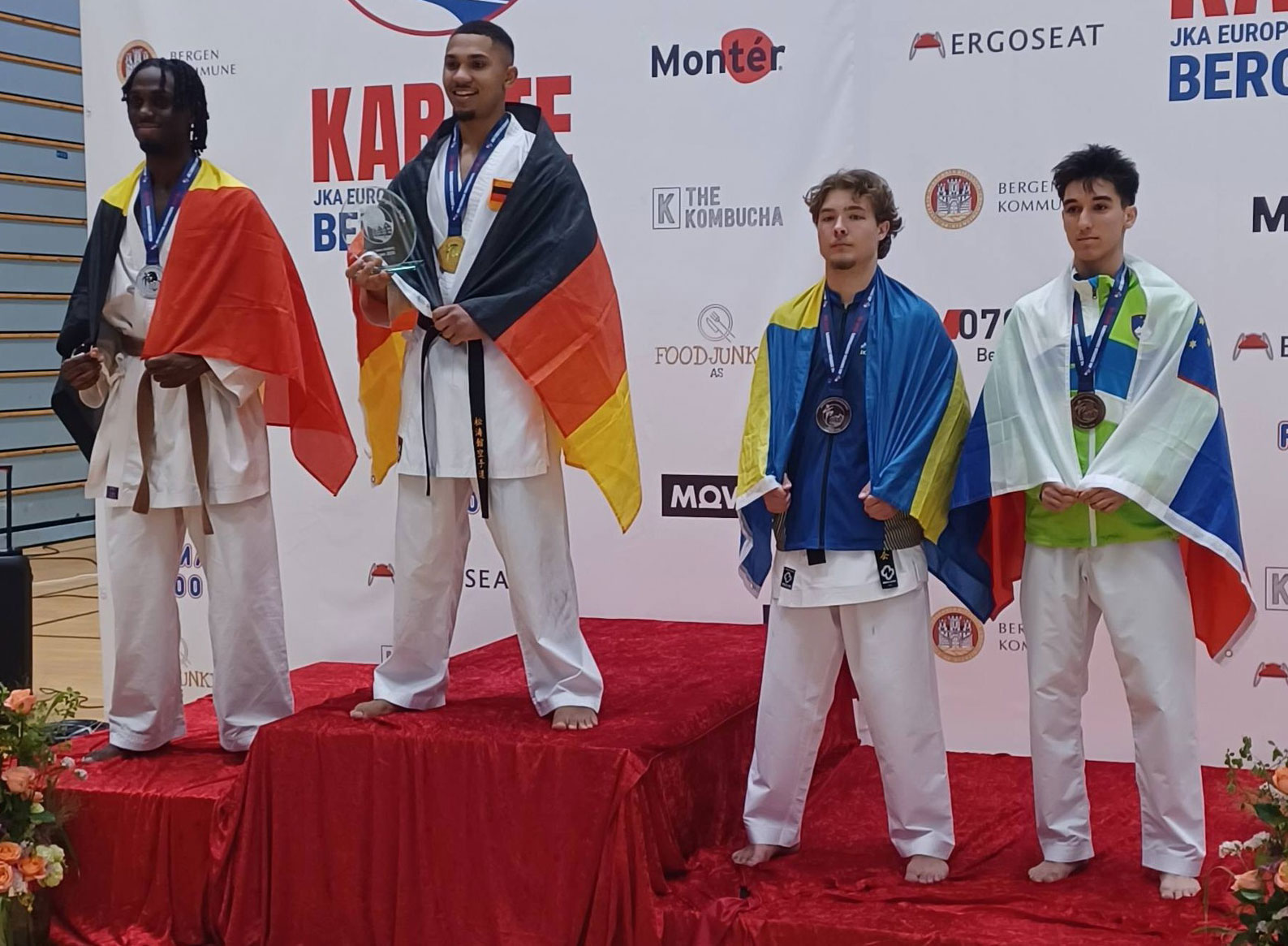
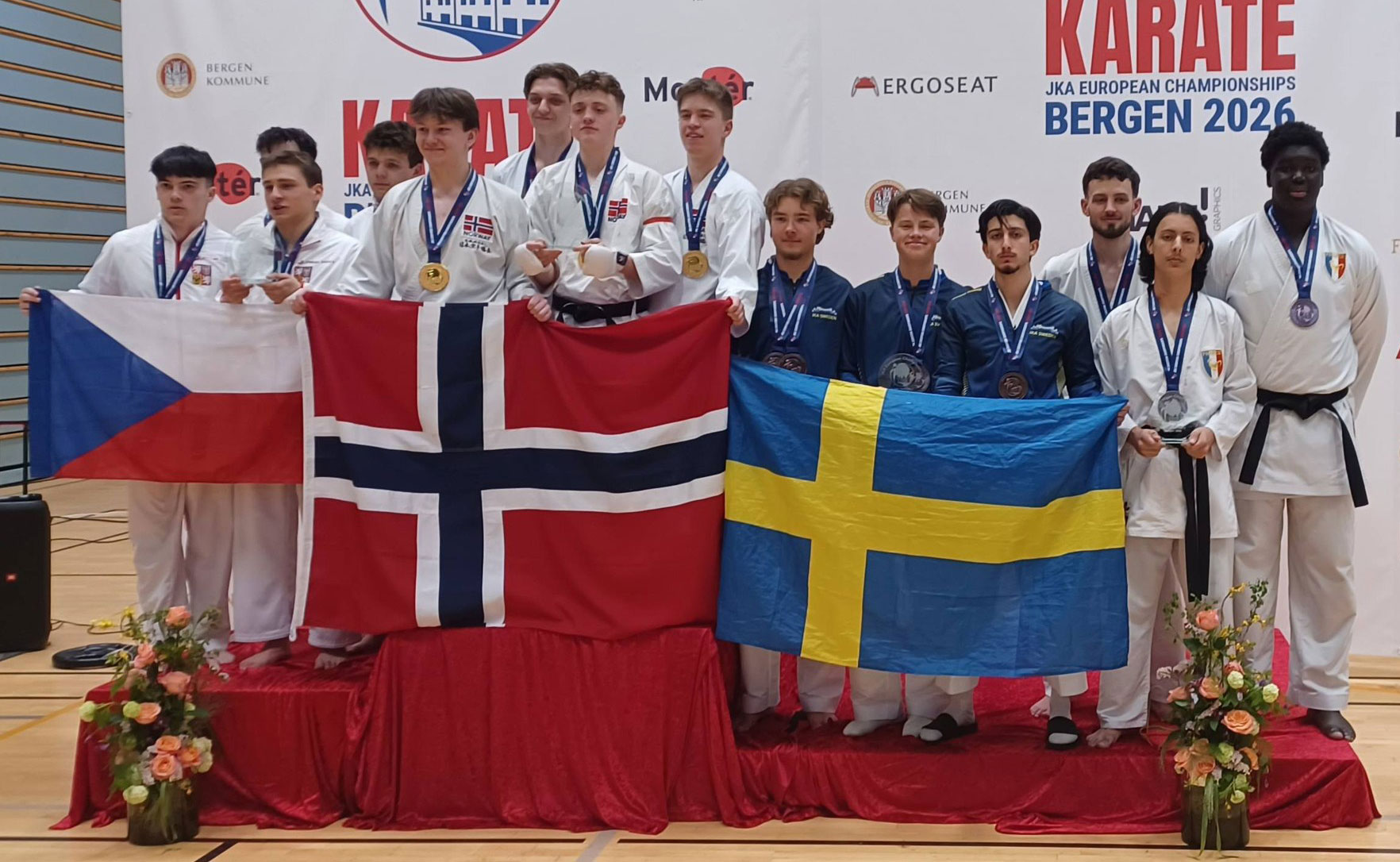
Mario Hallén from GAK Enighet won bronze in senior men’s individual kumite. He then joined Ali Eid from Landskrona Shotokan and Vilmer Ljungdahl from Lunds Karateklubb in the Swedish senior men’s team kumite squad, which also took bronze.
The senior medals mattered for several reasons. First, they gave Sweden a broader medal distribution across age levels. Second, they showed continuity between the younger generation and the established competitors. Third, they underlined the importance of clubs such as GAK Enighet, Landskrona Shotokan and Lunds Karateklubb in Sweden’s JKA structure.
Hallén’s individual bronze was particularly valuable because senior men’s kumite is one of the most demanding categories in any traditional karate championship. The physical tempo is high, the tactical decisions are fast, and mistakes are punished immediately. A medal in that environment requires experience, composure and the ability to stay sharp across multiple matches.
The team bronze added another layer. Team kumite at senior level often becomes a test of national squad culture. Sweden’s podium finish showed that the team could respond collectively, even after a long championship weekend.
A compact Swedish squad with a major return
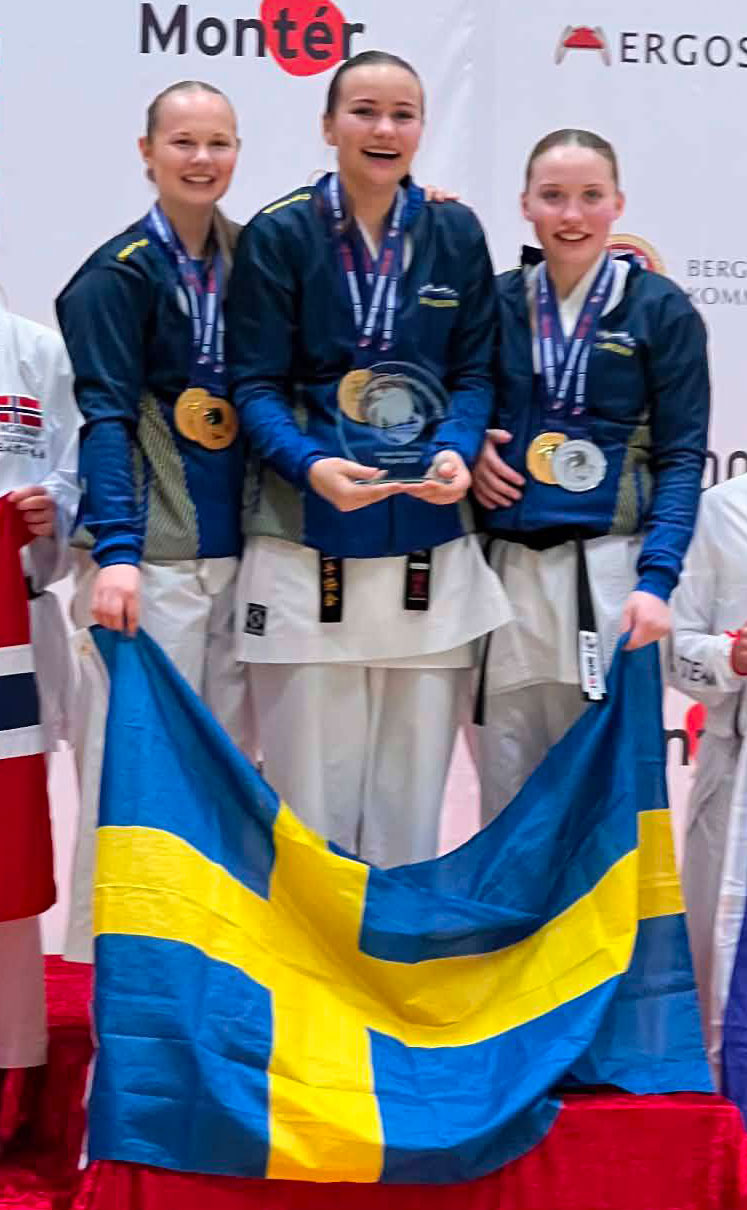
Sweden’s delegation consisted of 17 competitors in kata and kumite. The team was supported by coaches Robert Tegel and Andreas Schliker Andersson, with Miroslav Unic and Leslie Jensen serving as referees.
That context makes the medal tally even more impressive. With a relatively compact squad, Sweden returned from Bergen with nine medals in total. Not every athlete reached the podium, but JKA Sweden emphasised that the whole team produced strong performances, and that the effort bodes well for the future.
That is perhaps the most important conclusion. Championships are not only about the medal table. They are also about what a team learns, how younger athletes handle international pressure, how coaches assess the next step, and how national programmes build continuity.
For Sweden, Bergen offered both immediate success and long-term promise. The junior results were exceptional, but the senior bronze medals also showed that Swedish JKA karate has competitive presence beyond the youth categories.
Norway celebrates a historic home championship
While Sweden had every reason to celebrate, the host nation Norway also produced a championship to remember.
Norwegian Karate Association described the weekend as a fantastic one for the Norwegian team, highlighting individual gold for Marte Skodvin Mjåtvedt in women’s kumite, ahead of her sister Ingrid. Norway also celebrated gold in women’s team kumite with Marte Skodvin Mjåtvedt, Ingrid Mjåtvedt, Yuniar Wanda and Sunniva Syltevik, as well as gold for the boys in the 18–20 team kumite category.
JKA Norway also marked a historic moment: the first-ever Grand Champion award was presented in Bergen. According to JKA Norway’s public posts, the award required medals in both kata and kumite, with at least one of them being gold. The first recipient was Marte Skodvin Mjåtvedt, who became European champion in kumite and also took silver in kata.
That achievement made Mjåtvedt one of the central figures of the entire championship. Winning across both kata and kumite is rare at elite level. The two disciplines demand different strengths, different preparation and different competitive instincts. To medal in both, and win gold in one, is a mark of a truly complete karateka.
For Norway, having that moment happen on home soil gave the championship an extra emotional weight.
Bergen delivers atmosphere and organisation
The championship was also a major organisational undertaking. Bergen’s Haukelandshallen provided the stage, while the surrounding karate community helped turn the event into a genuine European gathering.
The official championship schedule included JKA Europe meetings and coach meetings before the competition, with junior categories taking place on Friday and senior/adult categories on Saturday. The programme also included Super Finals and a Sayonara Party, giving the event both a sporting and social structure.
Norwegian reporting highlighted the work behind the scenes, including the large volunteer effort and contributions from local clubs such as Bjørgvin Karateklubb, Nordås Karateklubb and Fjellsiden Karateklubb. That volunteer foundation is often invisible in medal summaries, but it is essential to championships of this size.
JKA Norway later thanked athletes, judges, coaches, families and friends for what it described as fantastic days in Bergen, pointing to the atmosphere, attitude and mutual respect throughout the event.
That phrase — mutual respect — is important. Traditional karate championships are built around more than victory. They are built around etiquette, discipline and the meeting of different dojos and nations under one shared framework. In Bergen, that spirit appears to have been central.
Other European medal stories emerge
Beyond Sweden and Norway, several other nations also celebrated success. Karate Club Kruševac reported a bronze medal in 14–15 team kata through Ivanovic Lion, Simic Lazar and Ristic Tadia. The result added Serbia to the wider medal story and showed again how broad the European JKA field has become.
Public posts from England also highlighted Jamie Langridge, who was described as having battled through a very tough category to win gold and become JKA European Champion in 2026. Other social media posts from clubs and federations across Europe showed the familiar post-championship rhythm: podium photos, team celebrations, short video clips, thanks to coaches and congratulations to athletes returning home with medals.
That social media footprint is now part of how championships live on. The official results give the structure, but the club posts show the emotion: the nervous build-up, the relief after a medal, the pride from team-mates, and the immediate recognition from local karate communities.
Sweden’s medal list from Bergen
Sweden finished with three gold, two silver and four bronze medals.
Gold went to Alma Roth in junior women’s individual kata; to Alma Roth, Mathilda Johansson and Ella Elezovic in junior women’s team kata; and to Aleksandra Tesic, Mathilda Johansson and Ella Elezovic in junior women’s team kumite.
Silver went to Mathilda Johansson in junior women’s individual kata and, according to JKA Sweden’s first-day summary, to Aleksandra Tesic in junior women’s kumite.
Bronze went to Ella Elezovic in junior women’s individual kata, Toffik Boughiout in junior men’s individual kumite, Mario Hallén in senior men’s individual kumite, and the senior men’s team kumite squad of Mario Hallén, Ali Eid and Vilmer Ljungdahl.
The distribution tells its own story. Sweden’s junior women were the engine of the medal haul, but the senior men also made sure the final total reflected a broader team effort.
A result that points forward
The JKA European Championships 2026 in Bergen will be remembered for several reasons: Norway’s successful hosting, Marte Skodvin Mjåtvedt’s historic Grand Champion award, the strong performances from the home nation, and the scale of a championship that gathered 23 nations in one of Norway’s most distinctive sporting cities.
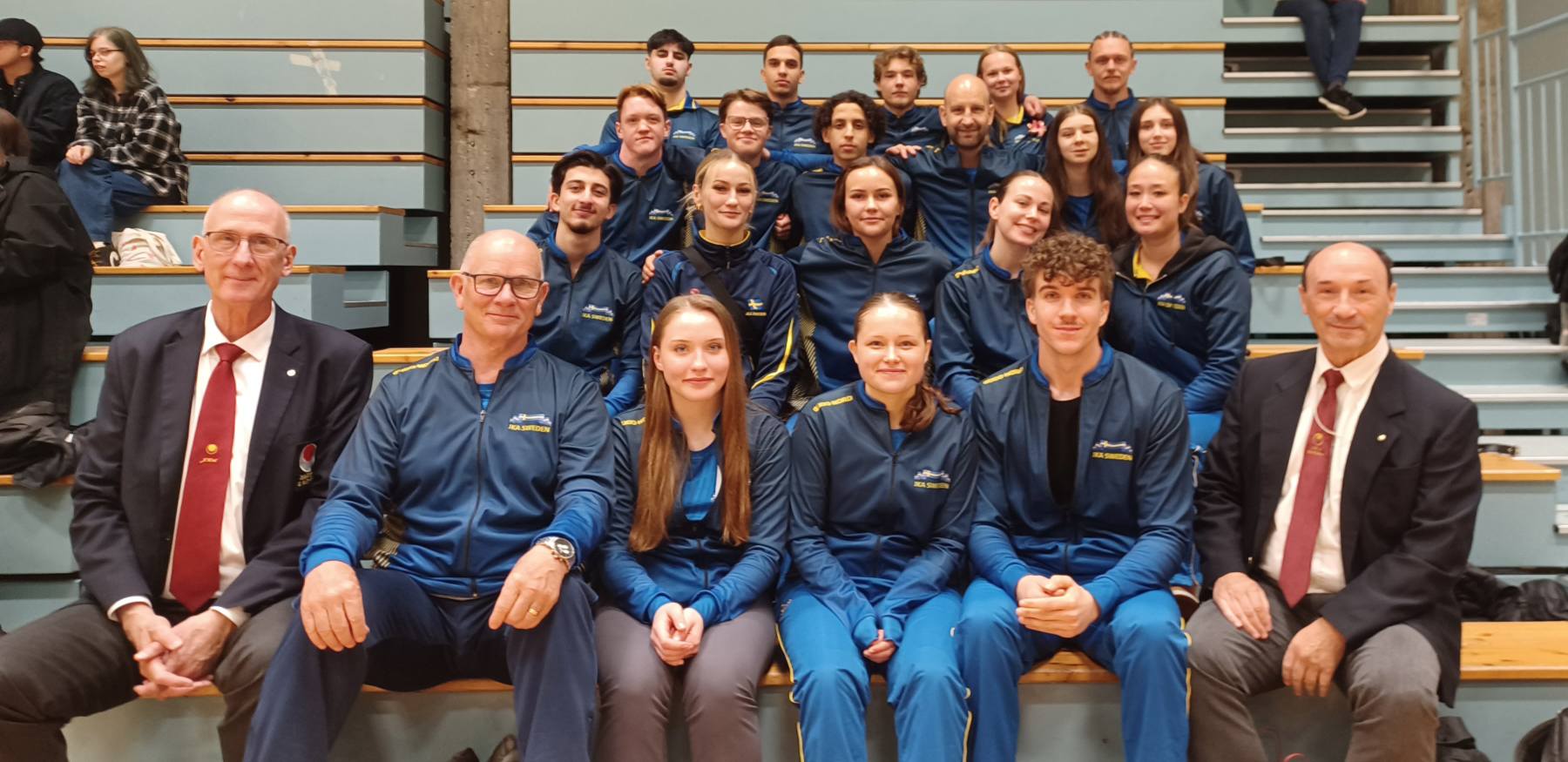
For Sweden, however, the headline is clear. The juniors delivered a breakthrough performance, and the seniors added important podium results. Three gold medals, two silver medals and four bronze medals is a strong return from any European championship. From a squad of 17 competitors, it is even stronger.
The most promising part may be the balance between individual brilliance and team success. Sweden won through individual kata, team kata, team kumite and individual kumite. That spread suggests not only strong athletes, but strong club environments and national coaching structures.
Bergen was not perfect for every Swedish competitor. JKA Sweden noted that not everyone went all the way this time. But championships are also built on those matches — the ones that do not become medals but still become experience.
The Swedish team left Norway with medals, confidence and a clear sign that the next generation is already capable of performing on the European stage. In a championship defined by respect, intensity and tradition, Sweden’s young karateka made one of the weekend’s strongest statements.
Bergen 2026 was not only a successful European Championship. For Swedish JKA karate, it may also prove to be an important marker for the future.
JKA European Championships 2026 Results
Blodig finalekamp under EM i karate i haukelandshallen i Bergen
Visa detta inlägg på Instagram
Visa detta inlägg på Instagram
Visa detta inlägg på Instagram
Visa detta inlägg på Instagram
Visa detta inlägg på Instagram
Visa detta inlägg på Instagram
Visa detta inlägg på Instagram
Visa detta inlägg på Instagram
Visa detta inlägg på Instagram
Visa detta inlägg på Instagram
Visa detta inlägg på Instagram